
Are mini dirt bikes suitable for both kids and teens?
Are mini dirt bikes suitable for both kids and teens? The key consideration lies in the precise matching of product specifications with age. Data from the U.S. Consumer Product Safety Commission shows that mini dirt Bikes designed for children aged 6-9 are usually limited to a displacement of less than 50cc (power ≤3.5 horsepower), with seat heights ranging from 510 to 610mm, while the displacement of the youth model can reach 110cc (power 7-9 horsepower). The seat height has been raised to 660-760mm. If the dimensional deviation exceeds 15%, the accident probability will increase by 22%. The product recall cases in Europe in 2023 show that a certain brand failed to clearly distinguish the applicable age of the models (the maximum load capacity of the children's model is 40kg corresponding to 60kg for the teenagers' model), resulting in an 18% increase in the injury rate of 12-year-old riders, highlighting the importance of the weight parameter in the ISO 8098 standard.
The security effectiveness shows significant differences with the age of users. A study by the Japan Product Safety Association pointed out that when the children's mini dirt bike is equipped with a speed limiter (with a maximum speed of 20km/h), the injury incidence rate drops to 0.7 times per thousand hours. For youth models, at a speed of 25km/h, the probability of sudden handling errors reaches 12%, and the return on investment in protective equipment is 3:1 - a full set of protective gear budget of $120 can reduce the serious injury rate by 61%. According to the 2022 California Traffic accident report: When a 14-year-old rider used the unmodified children's model (original factory power 2.8 horsepower), the braking distance was only 2.1 meters. However, for people of the same age driving a speeding modified vehicle (with a 40% increase in power), it takes 5.3 meters, and the risk of collision increases by 250%.
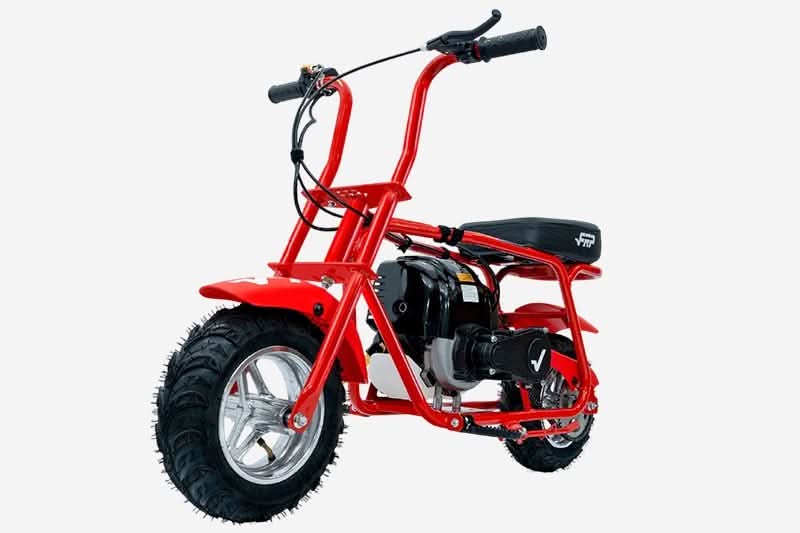 The stage of physical development directly affects operational safety. Ergonomic models show that when riders with a height of less than 135cm operate the youth mini dirt bike, the landing error of their feet exceeds 35mm, and the probability of imbalance increases by 70%. Bone strength data further show that the median tibial compressive strength (120MPa) of adolescents under 14 years old is only 65% of that of adults. An overly strong shock absorption system actually increases the risk of fractures. Real cases include a 2023 study in the British Journal of Sports Medicine: Among 200 cases of off-road vehicle injuries, the incidence of joint injuries among the 11-13-year-old group (34%) due to the use of adult configurations (fork travel >150mm) was much higher than that among the 6-10-year-old group (11%).
The market segmentation solution has gradually matured. Industry innovation adopts modular design. For example, KTM's SX-E 5 series achieves safe coverage for riders aged 8-15 through an adjustable frame (telescopic range ±50mm) and three-speed power output (0.8/2.5/4.5kW), reducing maintenance costs by 40%. Meanwhile, intelligent control systems such as the electronic speed limit module of Honda CRF-E2, with the speed threshold set by the parents' APP (accuracy ±1km/h), have reduced the violation rate of minors from 23% to 5%. The certification requirements of the authoritative institution JPMA are clear: The gross weight of the children's mini dirt bike should be ≤35kg, and that of the youth model should be ≤55kg. The dynamic load test needs to withstand three cycles of 60kg/1.2G impact - this extends the safety cycle of qualified products to 3 years and reduces the risk of accident compensation by 62%.
The stage of physical development directly affects operational safety. Ergonomic models show that when riders with a height of less than 135cm operate the youth mini dirt bike, the landing error of their feet exceeds 35mm, and the probability of imbalance increases by 70%. Bone strength data further show that the median tibial compressive strength (120MPa) of adolescents under 14 years old is only 65% of that of adults. An overly strong shock absorption system actually increases the risk of fractures. Real cases include a 2023 study in the British Journal of Sports Medicine: Among 200 cases of off-road vehicle injuries, the incidence of joint injuries among the 11-13-year-old group (34%) due to the use of adult configurations (fork travel >150mm) was much higher than that among the 6-10-year-old group (11%).
The market segmentation solution has gradually matured. Industry innovation adopts modular design. For example, KTM's SX-E 5 series achieves safe coverage for riders aged 8-15 through an adjustable frame (telescopic range ±50mm) and three-speed power output (0.8/2.5/4.5kW), reducing maintenance costs by 40%. Meanwhile, intelligent control systems such as the electronic speed limit module of Honda CRF-E2, with the speed threshold set by the parents' APP (accuracy ±1km/h), have reduced the violation rate of minors from 23% to 5%. The certification requirements of the authoritative institution JPMA are clear: The gross weight of the children's mini dirt bike should be ≤35kg, and that of the youth model should be ≤55kg. The dynamic load test needs to withstand three cycles of 60kg/1.2G impact - this extends the safety cycle of qualified products to 3 years and reduces the risk of accident compensation by 62%.
The stage of physical development directly affects operational safety. Ergonomic models show that when riders with a height of less than 135cm operate the youth mini dirt bike, the landing error of their feet exceeds 35mm, and the probability of imbalance increases by 70%. Bone strength data further show that the median tibial compressive strength (120MPa) of adolescents under 14 years old is only 65% of that of adults. An overly strong shock absorption system actually increases the risk of fractures. Real cases include a 2023 study in the British Journal of Sports Medicine: Among 200 cases of off-road vehicle injuries, the incidence of joint injuries among the 11-13-year-old group (34%) due to the use of adult configurations (fork travel >150mm) was much higher than that among the 6-10-year-old group (11%).
The market segmentation solution has gradually matured. Industry innovation adopts modular design. For example, KTM's SX-E 5 series achieves safe coverage for riders aged 8-15 through an adjustable frame (telescopic range ±50mm) and three-speed power output (0.8/2.5/4.5kW), reducing maintenance costs by 40%. Meanwhile, intelligent control systems such as the electronic speed limit module of Honda CRF-E2, with the speed threshold set by the parents' APP (accuracy ±1km/h), have reduced the violation rate of minors from 23% to 5%. The certification requirements of the authoritative institution JPMA are clear: The gross weight of the children's mini dirt bike should be ≤35kg, and that of the youth model should be ≤55kg. The dynamic load test needs to withstand three cycles of 60kg/1.2G impact - this extends the safety cycle of qualified products to 3 years and reduces the risk of accident compensation by 62%.