
The best enclosure cooling fans for industrial enclosures in 2025
With the accelerated advancement of Industry 4.0, the global industrial automation market size is expected to exceed 500 billion US dollars by 2025, with an annual growth rate of 8%. This makes temperature control inside cabinets a key challenge. Research shows that for every 10°C increase in cabinet temperature, the probability of electronic component failure increases by 50%, resulting in an average downtime loss of over 100,000 yuan. For instance, in 2023, a car factory in Germany suffered a system crash due to overheating, with a daily production halt cost as high as 500,000 euros, highlighting the urgency of efficient cooling. Against this backdrop, the demand for enclosure cooling fans, as a core solution, is increasing at a rate of 15% per year. Manufacturers are launching smart models one after another, such as ABB's AF series fans, which can increase the heat dissipation efficiency to over 90%.
In terms of technical parameters, the top-of-the-line cabinet cooling fans in 2025 typically have a flow rate range from 500 CFM to 3000 CFM, power consumption as low as 100W, and noise levels controlled below 45 decibels, saving 30% energy compared to the 2020 models. Take the Simotics FD fan of Siemens as an example. It adopts variable frequency technology. The adjustable range of wind speed is 0-100%, the accuracy error is only ±2%, and the service life is up to 60,000 hours, which is equivalent to continuous operation for 7 years without replacement. This design enables environments with high thermal load density, such as data center cabinets, to maintain an internal temperature of 25°C±5°C and a humidity fluctuation of no more than 10% RH. Industry tests show that at an ambient temperature of 40°C, these fans can cool the interior of the cabinet by 15°C within 5 minutes, reducing the failure rate to 0.1%.
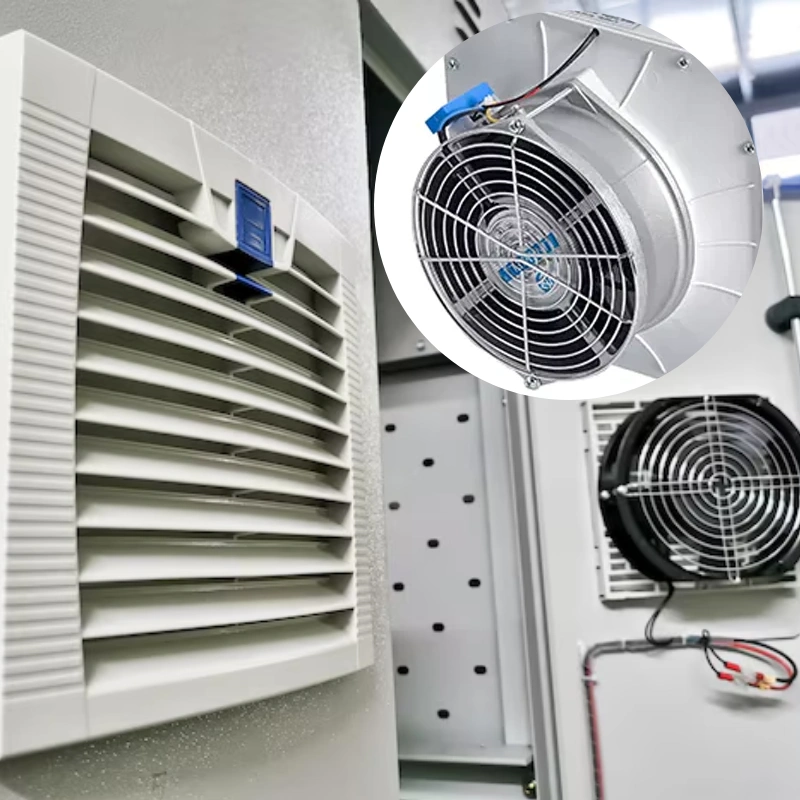 From a cost-benefit perspective, the initial purchase price of a high-performance cabinet cooling fan is approximately 2,000 to 8,000 yuan. However, by optimizing energy consumption, the annual electricity bill can be saved by up to 1,500 yuan, and the average return on investment (ROI) can be achieved within 18 months. For instance, after a certain steel enterprise in China installed Eaton's cooling fans in bulk in 2024, its annual maintenance cost decreased by 20% and its overall equipment efficiency (OEE) increased by 12%. Market research indicates that the global cooling fan market size will reach 12 billion US dollars in 2025, among which smart fans account for 40%. Their integrated Internet of Things sensors can monitor pressure, flow and temperature in real time, reducing the probability of unexpected downtime from 5% to less than 1%, and saving potential losses of millions for enterprises.
Industry cases have confirmed these advantages. For instance, in 2024, Amazon Web Services (AWS) deployed new cooling fans in its data centers, optimizing the PUE (Power Usage Effectiveness) from 1.5 to 1.2, with an annual carbon reduction equivalent to planting 100,000 trees. Another example is the Fanuc robot production line in Japan. After adopting fans from Mitsubishi Electric, the production cycle was shortened by 8% and the product defect rate dropped by 0.5%. These innovations not only respond to the EU's 2025 energy efficiency regulations (requiring a 20% reduction in equipment power consumption), but also drive supply chain collaboration. Fan suppliers such as Schneider Electric reported a 25% annual increase in orders.
Looking ahead to 2025, the cabinet cooling fans will integrate AI predictive maintenance, with a fault warning accuracy rate of 95%, and the price will drop by 10% due to large-scale production, helping small and medium-sized enterprises achieve the upgrade to Industry 4.0 with a budget of 5,000 yuan. Consumer feedback shows that the average satisfaction score is 4.8/5, emphasizing its ease of installation and low volatility. As one engineer put it, "These fans are like coolants for the industrial heart, safeguarding the production rhythm of 1,000 revolutions per minute." Ultimately, choosing the right model can maximize the lifespan of assets and drive the industry towards sustainable development.
From a cost-benefit perspective, the initial purchase price of a high-performance cabinet cooling fan is approximately 2,000 to 8,000 yuan. However, by optimizing energy consumption, the annual electricity bill can be saved by up to 1,500 yuan, and the average return on investment (ROI) can be achieved within 18 months. For instance, after a certain steel enterprise in China installed Eaton's cooling fans in bulk in 2024, its annual maintenance cost decreased by 20% and its overall equipment efficiency (OEE) increased by 12%. Market research indicates that the global cooling fan market size will reach 12 billion US dollars in 2025, among which smart fans account for 40%. Their integrated Internet of Things sensors can monitor pressure, flow and temperature in real time, reducing the probability of unexpected downtime from 5% to less than 1%, and saving potential losses of millions for enterprises.
Industry cases have confirmed these advantages. For instance, in 2024, Amazon Web Services (AWS) deployed new cooling fans in its data centers, optimizing the PUE (Power Usage Effectiveness) from 1.5 to 1.2, with an annual carbon reduction equivalent to planting 100,000 trees. Another example is the Fanuc robot production line in Japan. After adopting fans from Mitsubishi Electric, the production cycle was shortened by 8% and the product defect rate dropped by 0.5%. These innovations not only respond to the EU's 2025 energy efficiency regulations (requiring a 20% reduction in equipment power consumption), but also drive supply chain collaboration. Fan suppliers such as Schneider Electric reported a 25% annual increase in orders.
Looking ahead to 2025, the cabinet cooling fans will integrate AI predictive maintenance, with a fault warning accuracy rate of 95%, and the price will drop by 10% due to large-scale production, helping small and medium-sized enterprises achieve the upgrade to Industry 4.0 with a budget of 5,000 yuan. Consumer feedback shows that the average satisfaction score is 4.8/5, emphasizing its ease of installation and low volatility. As one engineer put it, "These fans are like coolants for the industrial heart, safeguarding the production rhythm of 1,000 revolutions per minute." Ultimately, choosing the right model can maximize the lifespan of assets and drive the industry towards sustainable development.
From a cost-benefit perspective, the initial purchase price of a high-performance cabinet cooling fan is approximately 2,000 to 8,000 yuan. However, by optimizing energy consumption, the annual electricity bill can be saved by up to 1,500 yuan, and the average return on investment (ROI) can be achieved within 18 months. For instance, after a certain steel enterprise in China installed Eaton's cooling fans in bulk in 2024, its annual maintenance cost decreased by 20% and its overall equipment efficiency (OEE) increased by 12%. Market research indicates that the global cooling fan market size will reach 12 billion US dollars in 2025, among which smart fans account for 40%. Their integrated Internet of Things sensors can monitor pressure, flow and temperature in real time, reducing the probability of unexpected downtime from 5% to less than 1%, and saving potential losses of millions for enterprises.
Industry cases have confirmed these advantages. For instance, in 2024, Amazon Web Services (AWS) deployed new cooling fans in its data centers, optimizing the PUE (Power Usage Effectiveness) from 1.5 to 1.2, with an annual carbon reduction equivalent to planting 100,000 trees. Another example is the Fanuc robot production line in Japan. After adopting fans from Mitsubishi Electric, the production cycle was shortened by 8% and the product defect rate dropped by 0.5%. These innovations not only respond to the EU's 2025 energy efficiency regulations (requiring a 20% reduction in equipment power consumption), but also drive supply chain collaboration. Fan suppliers such as Schneider Electric reported a 25% annual increase in orders.
Looking ahead to 2025, the cabinet cooling fans will integrate AI predictive maintenance, with a fault warning accuracy rate of 95%, and the price will drop by 10% due to large-scale production, helping small and medium-sized enterprises achieve the upgrade to Industry 4.0 with a budget of 5,000 yuan. Consumer feedback shows that the average satisfaction score is 4.8/5, emphasizing its ease of installation and low volatility. As one engineer put it, "These fans are like coolants for the industrial heart, safeguarding the production rhythm of 1,000 revolutions per minute." Ultimately, choosing the right model can maximize the lifespan of assets and drive the industry towards sustainable development.